What happens when a domain expires, and how to prevent it
An expired domain takes site and email offline, and can be lost for good. The phases after expiry, why it happens to careful businesses, and four safeguards.
The short answer
A domain is rented, usually per year, and when the rental lapses the website and email that depend on it stop working. That alone is a bad day. The worse outcome is that after a series of phases the domain is released and someone else registers it, taking the address your customers know and your email identity with it.
It rarely happens through carelessness. It happens because a card expired, or because the renewal reminders went to a former employee’s mailbox.
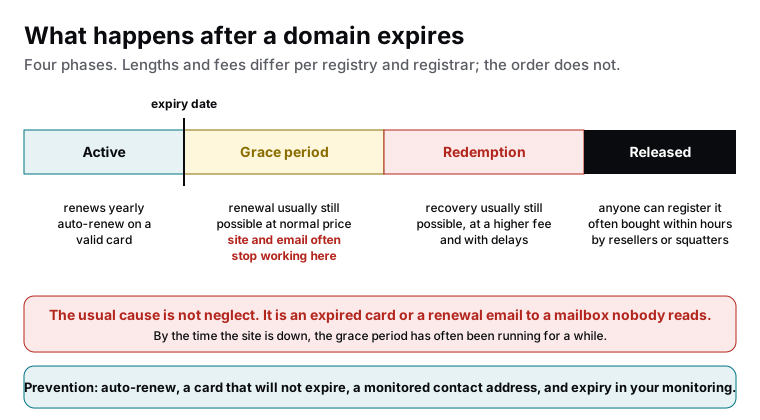
The phases
| Phase | What it means | What you can do |
|---|---|---|
| Active | The domain is registered and renews on its date | Keep it that way |
| Grace period | Past the expiry date; the registrar usually still allows renewal at the normal price. Site and email often stop working during this phase | Renew immediately through your registrar account |
| Redemption | The domain is held; recovery is usually still possible but at a higher fee and with delays | Pay the recovery fee; expect days rather than minutes |
| Released | The domain returns to the open market | Hope nobody else wanted it, and register it again if you are fast |
Why it happens to careful businesses
- The card on file expired. Auto-renew was on; the payment failed; the failure email went to a mailbox nobody checks.
- The contact address is dead. The domain was registered years ago by someone who left. Every reminder since has gone nowhere.
- The registrar account belongs to a supplier. They renewed it for years, then stopped, closed, or forgot, and nobody at the business had a login to notice.
- Fake notices trained everyone to ignore real ones. After a few scam letters, the genuine reminder is thrown away with them.
The four safeguards
- Auto-renew on, at the registrar, for every domain the business uses, including the old ones that redirect.
- A card that will not expire, ideally a company card with a long validity, and a calendar note to update it before it does.
- A monitored contact address on the registration: a shared mailbox that will outlive any employee, checked by more than one person.
- Expiry in your monitoring, with an alert months ahead, not days. A domain check costs nothing and prevents the most avoidable outage there is.
What this means for you
A domain expiring is the most preventable outage a business can have, and one of the most damaging when it goes all the way to release. Check the registrar account, put the four safeguards in place, and make sure the account is in your company’s name. Ten minutes now, and the phases above stay a diagram instead of an incident.
Frequently asked questions
How long do we have after the expiry date?
It depends on the registry and the registrar. There is usually a grace period in which renewal is possible at the normal price, then a redemption period in which recovery is still possible at a higher fee and with delays, then release. Do not plan around the lengths; plan not to reach them.
Can someone take our domain if it expires?
Once it is released, anyone can register it, and domains with history are often bought within hours by resellers who then offer them back at a price, or use them for their own purposes. That is the outcome the safeguards exist to prevent.
We got a renewal notice from a company we do not recognise. Is it real?
Possibly not. Fake renewal notices are a common scam, especially by post. Renew only through your own registrar account, never through a link or a form in an unsolicited notice. If unsure, log in to the registrar directly and check the expiry date there.
Sources
- ICANN: Expired Registration Recovery Policy (accessed 2026-09-11)