Shared hosting, VPS, cloud, edge: what the words mean for your business
Shared hosting, VPS, cloud, serverless, edge: five words that describe who runs what. What each means for speed, cost and responsibility, in plain terms.
The short answer
Hosting words describe one thing: how much of the stack you are responsible for. At one end, shared hosting and a VPS give you a machine or a slice of one, and everything on it is your job. At the other end, serverless and edge platforms run the machines, the operating system and the scaling, and you provide only your site or your functions.
For a business website, the right end is the second one.
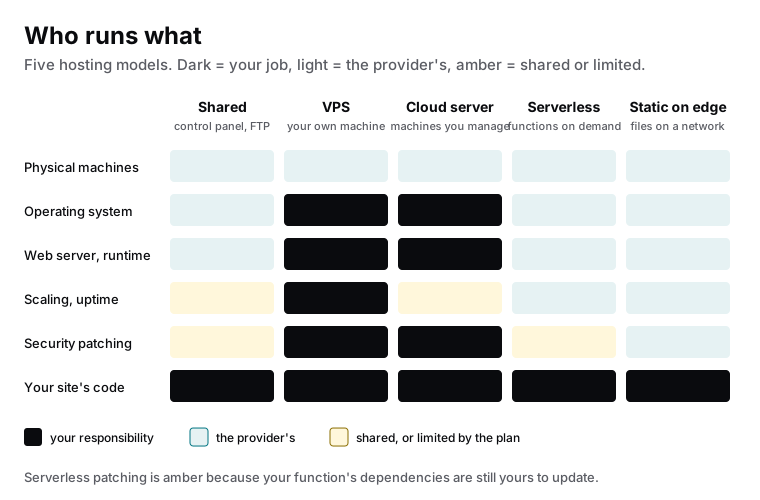
The five, in plain terms
Side by side
| Shared | VPS | Cloud server | Serverless | Static on edge | |
|---|---|---|---|---|---|
| You maintain | Your code | Everything above the hardware | Everything above the hardware | Your functions | Your code |
| Speed worldwide | Poor | One location | One or few locations | Good | Best |
| Traffic spike | Falls over | Falls over unless oversized | Scales if configured | Scales automatically | Absorbed |
| Security patching | Provider for the server, you for the site | You | You | Provider | Provider |
| Cost shape | Low, flat | Flat, plus your time | Hourly, plus your time | Per use | Low, flat |
| Right for | Hobby sites | Teams with a sysadmin | Applications with specific needs | Forms, APIs, app backends | Business websites, content, storefronts |
What we choose, and why
For company websites, landing pages, knowledge bases and shop storefronts: a static build on an edge network, with serverless functions for forms and small dynamic pieces. Nothing to patch, fast everywhere, low and predictable cost, and it survives launches and campaigns without anyone watching a dashboard.
For applications with logins and databases: serverless functions plus a managed database where the workload fits, or a managed server where it does not, chosen per project and per region, including EU-only when the data requires it.
What this means for you
Find out which of the five words describes your current site, and who the administrator is. If it is shared hosting or a VPS that nobody maintains, the move to a static build on an edge network is the single most effective change you can make to speed, security and running cost, and it is a normal part of a website rebuild.
Frequently asked questions
Is a VPS better than shared hosting?
It gives you a machine of your own instead of a slice shared with strangers, so it is more predictable and more powerful. It also makes you the administrator: operating system updates, web server configuration, security patching and backups become your job. That trade is not worth it when static and serverless options exist.
What does cloud mean here?
Renting computing from a large provider by the hour, with the ability to add or remove capacity. A cloud server is still a server you manage. The word is used loosely; ask whether you are renting a machine you administer or a service the provider runs.
What is serverless if there are still servers?
Servers exist, but you never see or manage them. You provide small functions, the provider runs them on demand and bills per use. Nothing runs when nobody is using it, which is why it is cheap for spiky traffic and why there is nothing to patch.
Which one should a business website use?
For a company website, landing pages and content: a static build served from an edge network, with serverless functions for forms. For an application with logins and a database: serverless or a managed server, chosen per project. Shared hosting and self-managed VPS are rarely the right answer for a business in 2026.
Sources
- Cloudflare Learning Center: What is serverless? (accessed 2026-09-11)
- Cloudflare Learning Center: What is a CDN? (accessed 2026-09-11)