Why we don't build business websites on page builders
Page builders are fine for a weekend project. For a business that depends on its website, they cost more than they save. Our reasoning, and the exceptions.
Our position, stated plainly
This is an opinion piece, and it is our opinion. Here is why we hold the line, and where we would break it.
Reason 1: the pages are slower than they need to be
A page builder has to work for every kind of site at once. To do that, it ships a large amount of code to every visitor, whether the page uses it or not. On a fast laptop you barely notice. On a mid-range phone over mobile data, which is where most first visits happen, you do.
Google publishes clear targets for what a fast page is: main content visible within 2.5 seconds, reaction to a tap within 200 milliseconds, almost no layout jumping. Builder sites can be pushed under those numbers, but it takes constant effort against the tool. A site built from code starts there by default.
Reason 2: you do not own the result
Export a builder site and see what you get. In most cases you get your text and your images. The layout, the interactions, the structure that you paid to have designed, stays in the builder. Leaving means rebuilding.
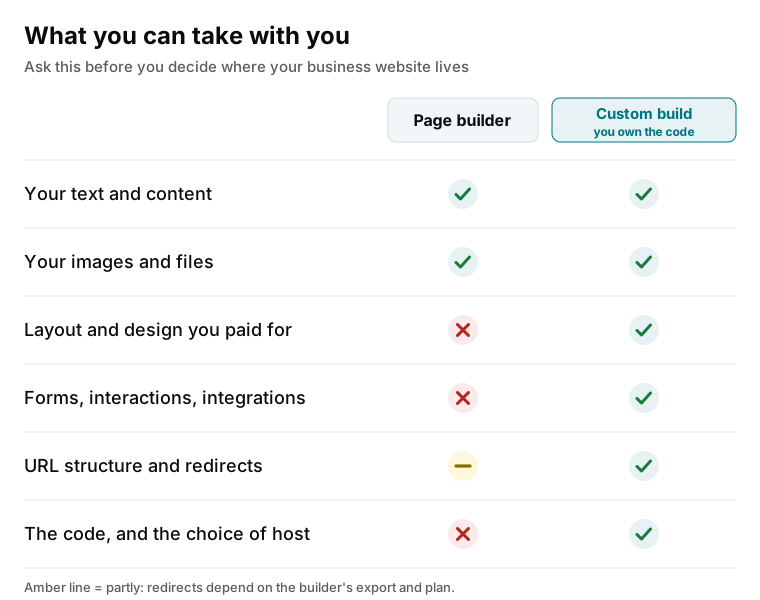
That is the quiet cost of the model. The monthly fee is not for hosting; it is for permission to keep using your own website. We think a business website should be something you own outright, code included, and can move to any host in an afternoon. That is written into every proposal we send.
Reason 3: control over accessibility and security is limited
The European Accessibility Act now requires many businesses in the EU, including anyone selling online, to make their digital services accessible. Meeting that standard means controlling the details: heading structure, contrast, focus states, form labels. Builders let you influence some of it and hide the rest.
Security is similar. A builder platform is patched by the vendor, which is convenient. A builder plugin on WordPress is patched by you, or not, and the plugin stack is where most of the findings in our security scans come from.
Reason 4: the three-year bill
Add it up honestly. The table below has no prices on purpose, because they differ per builder and per country. Fill in your own numbers.
| Cost line | Page builder | Custom build you own |
|---|---|---|
| Platform plan | Monthly, for as long as the site exists | None. Hosting only, at any provider you choose |
| Premium template and add-ons | Recurring, per feature | Included in the build |
| Developer hours working around the tool | Every time you want something it was not designed for | Only for real changes |
| Rebuild when you outgrow it | Almost certain | Not needed. The code grows with you |
| What you own at the end | Text and images | Everything, code included |
Compared to that, a fixed-price custom build that you own, with speed and accessibility guaranteed in writing, overtakes it at the point where the subscription, the add-ons and the work around the builder’s limits pass the one-off price. Not always. But usually.
Where we would still say yes to a builder
What this means for you
If you are on a builder today and the site is doing its job, there is no emergency. Measure it on a phone, run a security check, and look at what you pay per year. If the numbers are fine, carry on. If they are not, or if the business now depends on the site, that is the moment a custom build stops being a luxury and becomes the cheaper option.
Frequently asked questions
Are page builders bad?
No. They are good at what they were designed for: getting something online quickly without a developer. The problem starts when a business grows and the site becomes a sales channel, because the trade-offs that were fine on day one now cost money every day.
Can you migrate my page-builder site to a custom build?
Yes. Content, images, and URLs can be carried over, and redirects keep your Google rankings intact. What cannot be exported is the builder's page structure itself, which is exactly why we rebuild it properly rather than copying it.
Is a custom website not much more expensive?
Upfront, often yes. Over three years, usually no. A builder's monthly plan, premium add-ons, and the developer hours spent fighting the builder add up, and you still do not own the result. Our website packages each cover a defined scope with everything included, you get a fixed proposal, and the code transfers to you.
What about WordPress with a builder plugin?
Same trade-offs, plus a plugin stack that needs constant security updates. WordPress can be run well, but a builder plugin on top of it is a slow and fragile combination we see in security scans.
Sources
- Google web.dev: Web Vitals thresholds (accessed 2026-09-11)
- W3C Web Accessibility Initiative: WCAG 2 overview (accessed 2026-09-11)
- European Commission: European Accessibility Act (EAA) (accessed 2026-09-11)